
How Much Is My RMD at Age 73? Examples and Percentages
By RMDCalculators.com · Published
You spent years putting money into retirement accounts. Now, at 73, you may be thinking how much you actually need to take out.
The answer is more simple than it sounds.
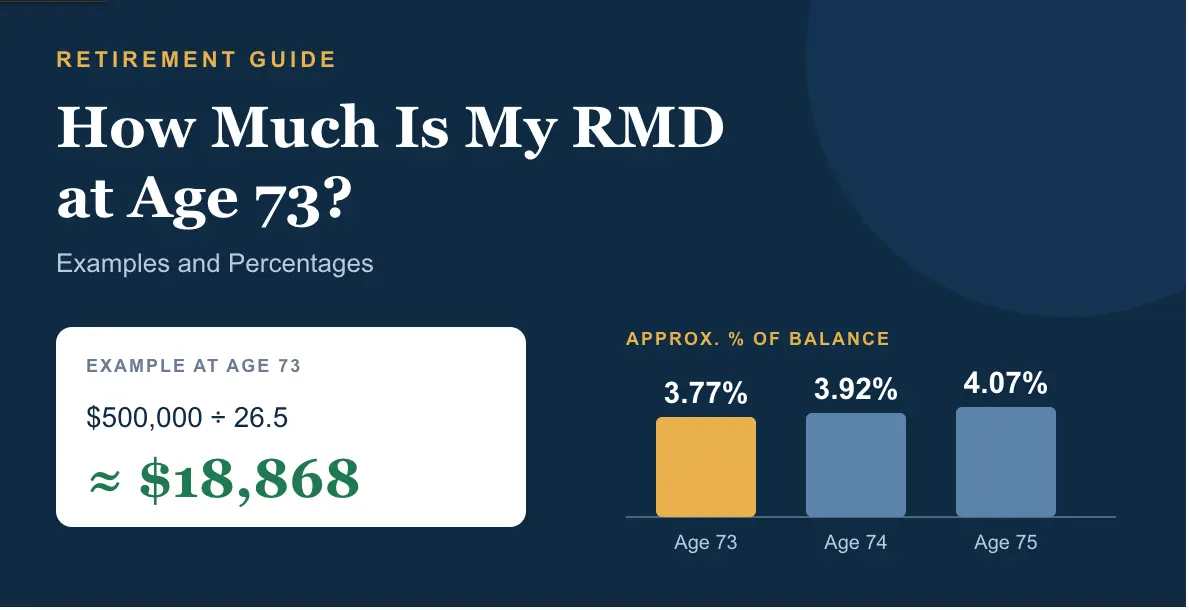
For most people using the IRS Uniform Lifetime Table, the RMD at age 73 equals approximately 3.77% of the account’s balance on December 31 of the previous year. That means a $100,000 balance produces an annual withdrawal requirement of about $3,773.59.
But the balance date, account type, and applicable IRS table matter. Let’s walk through the calculation, some practical examples, and the details that can change your result.
What Is the RMD Percentage at Age 73?
An RMD, or required minimum distribution, is the minimum amount you must withdraw from certain retirement accounts each year once the rules apply to you.
At age 73, the IRS Uniform Lifetime Table uses a distribution factor of 26.5.
Dividing 100 by 26.5 gives approximately 3.7736%. Rounded to two decimal places, that becomes 3.77%.
This percentage describes a withdrawal requirement. It is not your tax rate, and it does not mean your investments must earn that amount.
For an accurate calculation, divide your balance by 26.5 instead of multiplying it by the rounded percentage. Using 3.77% alone can leave your withdrawal slightly short.
How to Calculate Your RMD at Age 73
The standard formula is straightforward:
Annual RMD = Previous December 31 account balance ÷ 26.5
Suppose you turn 73 during 2026 and your traditional IRA held $250,000 on December 31, 2025. Your calculation would be:
$250,000 ÷ 26.5 = $9,433.96
That is your estimated required withdrawal for 2026, assuming the Uniform Lifetime Table applies and no special adjustments are needed.
Use your age on your birthday during the distribution year. You do not calculate a smaller requirement simply because your birthday falls late in December.
Also, use the correct account statement. Today’s investment balance might be higher or lower, but the standard calculation starts with the previous year’s closing balance. You can check your own numbers with our RMD calculator.
RMD Examples for Different Retirement Balances
These examples show how the same factor works across several account sizes. Every figure assumes age 73 and the standard 26.5 divisor.
| Previous December 31 balance | Annual RMD | Approximate monthly equivalent |
|---|---|---|
| $100,000 | $3,773.59 | $314.47 |
| $250,000 | $9,433.96 | $786.16 |
| $500,000 | $18,867.92 | $1,572.33 |
| $750,000 | $28,301.89 | $2,358.49 |
| $1,000,000 | $37,735.85 | $3,144.65 |
The monthly column is simply the annual amount divided by twelve. It helps with budgeting; it does not create a separate monthly IRS requirement.
Figures are rounded to cents. If you arrange monthly payments, check the total before your deadline and adjust the final payment when necessary.
For example, twelve payments of $314.47 total $3,773.64. That slightly exceeds the calculated requirement for a $100,000 balance, which avoids a rounding shortfall.
A Practical Example With a $500,000 IRA
Imagine someone named Linda turns 73 in 2026. Her traditional IRA balance was $500,000 at the end of 2025.
Using the standard factor, her RMD is approximately $18,867.92.
Linda could request one withdrawal or spread it across the year. If regular deposits make her household budget easier to manage, monthly payments might feel more convenient.
The useful question is how the withdrawal fits alongside her other income and expenses.
She might earmark part for everyday spending and set aside another portion for taxes. Before choosing withholding, she would need to consider her overall tax situation rather than assume the RMD percentage tells her what she owes.
When Is Your First RMD Due?
If you turn 73 in 2026, your first traditional IRA RMD is for 2026. You generally have until April 1, 2027, to take it.
However, waiting creates another deadline to remember.
Your second RMD, covering 2027, is due by December 31, 2027. Delaying the first withdrawal can therefore put two required distributions into the same calendar year.
That may increase your taxable income for that year.
Taking the first distribution during 2026 instead can spread those withdrawals across separate tax years. Whether that works better depends on your other income and circumstances.
A practical approach is to compare both years before choosing the later deadline.
Does Everyone Use the 26.5 Factor?
No. The standard example fits many account owners, but there are important exceptions.
If your spouse is your sole beneficiary and is more than ten years younger, you generally use the IRS Joint Life and Last Survivor Expectancy Table. That calculation considers both ages and typically produces a smaller required withdrawal.
Inherited retirement accounts have different rules. Do not automatically use 26.5 just because you are 73 when you inherit an IRA. See our inherited IRA RMD calculator.
Roth IRAs and designated Roth workplace accounts have no lifetime RMD requirement for their original owners.
Some people still working can also delay RMDs from their current employer’s retirement plan if the plan permits and ownership restrictions do not apply. That exception does not postpone traditional IRA RMDs.
What If You Have Multiple Accounts?
Suppose you own two traditional IRAs with previous December 31 balances of $200,000 and $300,000.
Calculate each account’s RMD separately. Using the standard factor, those amounts are approximately $7,547.17 and $11,320.75.
Together, they total about $18,867.92.
For your own traditional IRAs, you can generally withdraw that combined requirement from one IRA or divide it among them.
Separate 401(k) plans generally require separate withdrawals from each plan. Taking extra from an IRA does not satisfy a 401(k) requirement.
Keeping a short account checklist for your records can make this easier: record each balance, calculated requirement, withdrawals already taken, and remaining amount.
How Much Tax Will You Pay?
Your RMD amount and your tax bill are different calculations.
Traditional IRA distributions are generally taxable income, although any applicable after-tax basis can make part of a distribution nontaxable. The actual tax depends on your wider financial picture.
A $9,433.96 RMD does not mean you owe $9,433.96 in tax. It means that amount must generally leave the account to satisfy the withdrawal requirement.
Ask your provider how withholding affects the amount deposited into your bank account, and keep records of the gross distribution.
You may withdraw more than your RMD, but the excess cannot count toward next year’s requirement.
A Few Mistakes Worth Avoiding
Before requesting a withdrawal, check whether distributions already taken this year count toward your requirement. You may have satisfied some or all of it through regular retirement income payments.
Also, confirm that automatic withdrawals are actually scheduled. Seeing an estimated RMD on a statement does not necessarily mean the provider will send it without instructions.
Finally, avoid leaving everything until the deadline. Allow time for processing, questions, and corrections. A quick review a few weeks ahead can help you catch a missing payment while there is still time to address it.
Conclusion
For most account owners, calculating an RMD at age 73 starts with two numbers: your previous December 31 balance and the IRS factor of 26.5.
Divide the balance by that factor to find the annual requirement. The result is approximately 3.77%, with a $100,000 account producing an RMD of about $3,773.59.
Then check your account type, beneficiary situation, and deadline. Once those details are clear, you can plan withdrawals around your budget and approach the year with fewer surprises.
Source: IRS Uniform Lifetime Table and RMD guidance at irs.gov. Educational estimate only, not tax advice.