
How to Calculate Your RMD for 2026
By RMDCalculators.com · Published
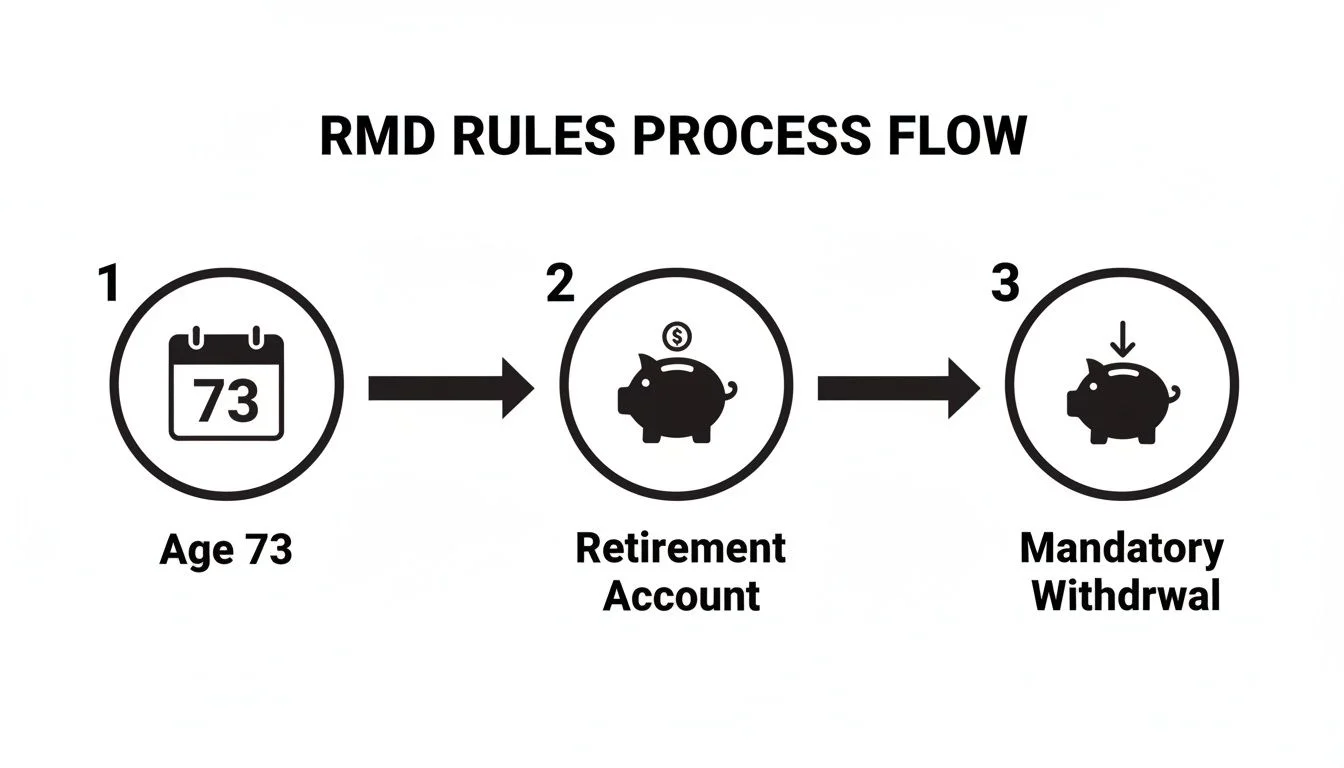
Calculating your required minimum distribution starts with two numbers: your retirement account balance and the correct IRS distribution factor.
For most account owners, the formula is:
2026 RMD = December 31, 2025, account balance ÷ applicable IRS factor
If you turn 73 in 2026 and have a $265,000 traditional IRA balance from that date, dividing by 26.5 gives a $10,000 RMD.
The arithmetic is straightforward. Choosing the right balance, age, and table takes more care. This guide walks through the calculation, explains common exceptions, and shows how to work out what you still need to withdraw before your deadline.
Step 1: Check Whether You Need a 2026 RMD
Before doing the calculation, confirm that the account is subject to required withdrawals.
Traditional IRAs, SEP IRAs, SIMPLE IRAs, and many workplace retirement plans generally have RMD requirements once the applicable starting rules apply.
If you turn 73 in 2026, your first traditional IRA RMD is generally for 2026. If you already started taking RMDs, you normally calculate a new amount each year. Not sure when your own withdrawals begin? The RMD starting-age calculator works out your first distribution year and deadline from your birth date.
Your own Roth IRA and designated Roth workplace accounts have no lifetime RMD requirement under current rules.
Some employees can postpone RMDs from their current employer’s plan until retirement, subject to plan terms and ownership restrictions. That exception generally does not cover traditional IRAs.
Step 2: Find Your December 31, 2025, Balance
For a standard 2026 calculation, use the account’s value at the end of December 31, 2025.
Your current balance is not the starting point. Neither is the amount you originally contributed or the balance from your birthday.
Look for your year-end statement or ask the account provider for the balance used in its RMD calculation.
For example, suppose your IRA held $400,000 on December 31, 2025, but is worth $425,000 when you check it during 2026. You generally calculate the 2026 requirement using $400,000.
Certain outstanding rollovers, transfers, or other special circumstances can require adjustments. Ask your provider about these if money was moving between accounts around year-end.
Step 3: Use Your Age During 2026
Use the age you reach on your birthday in 2026.
If you begin January at 74 and turn 75 in November, the standard calculation uses the factor for age 75.
You do not switch factors after your birthday or calculate separate amounts for different months.
This is a common source of mistakes when people calculate early in the year. Check your birth date against the distribution year before selecting the table entry.
For most original account owners, the factor comes from the IRS Uniform Lifetime Table. However, confirm that this is the correct table before continuing.
Step 4: Choose the Correct IRS Table
The Uniform Lifetime Table generally applies if you are unmarried, your spouse is not your sole beneficiary, or your spouse is not more than ten years younger.
If your spouse is your sole beneficiary and is more than ten years younger, you generally use the Joint Life and Last Survivor Expectancy Table. That table considers both spouses’ ages. You can compare every factor in our guide to the IRS RMD tables.
Inherited accounts follow separate beneficiary rules. Do not apply an original owner’s calculation automatically to an inherited IRA — see our inherited IRA RMD calculator.
Here are selected Uniform Lifetime Table factors and their approximate withdrawal percentages:
| Age in 2026 | IRS factor | Approximate percentage |
|---|---|---|
| 73 | 26.5 | 3.77% |
| 74 | 25.5 | 3.92% |
| 75 | 24.6 | 4.07% |
| 76 | 23.7 | 4.22% |
| 77 | 22.9 | 4.37% |
| 78 | 22.0 | 4.55% |
| 79 | 21.1 | 4.74% |
| 80 | 20.2 | 4.95% |
These percentages are useful for estimates. For the actual calculation, divide by the factor rather than multiplying by a rounded percentage.
Step 5: Divide the Balance by the Factor
Suppose you turn 75 in 2026 and your traditional IRA held $500,000 on December 31, 2025. Using the Uniform Lifetime Table:
$500,000 ÷ 24.6 = $20,325.20
Your calculated annual RMD is approximately $20,325.20, rounded to cents. Now consider someone turning 80 with a $300,000 balance:
$300,000 ÷ 20.2 = $14,851.49
The different factor explains why age matters alongside the account balance. You can check your own numbers with our RMD calculator.
These are withdrawal amounts, not tax bills. The tax owed depends on the taxable portion of your distributions and your overall tax situation.
Keep the calculation with your account records so you can compare it with your provider’s estimate.
Step 6: Calculate Each Account Separately
If you own multiple accounts, calculate the requirement for each one before deciding where to withdraw money.
Imagine two traditional IRAs with balances of $159,000 and $106,000. At age 73, using 26.5, their RMDs are $6,000 and $4,000. Your combined requirement is $10,000.
For your own traditional IRAs, you can generally withdraw that total from one IRA or spread it across them.
Separate 401(k) plans generally require their own distributions. An IRA withdrawal cannot simply replace a required withdrawal from a 401(k) — the 401(k) RMD calculator estimates plan withdrawals separately.
Multiple 403(b) accounts have their own aggregation rule. Confirm the account categories before combining amounts or scheduling payments.
Step 7: Subtract Qualifying Withdrawals Already Taken
The annual calculation tells you the total requirement. You may already have satisfied part of it.
Suppose your 2026 RMD is $10,000 and you have taken $6,000 in qualifying distributions from the appropriate account or permitted account group. Your remaining requirement is:
$10,000 minus $6,000 = $4,000
Use gross distribution amounts, including any tax withheld, rather than just the money deposited into your bank account. Our RMD tax withholding calculator shows how withholding changes the net amount you receive.
Eligible qualified charitable distributions can also count toward an IRA RMD. Ordinary withdrawals from a Roth IRA do not satisfy a traditional IRA requirement.
Review your transaction history before requesting another payment, particularly if automatic withdrawals are active.
Know Which Deadline Applies
Most 2026 RMDs must be completed by December 31, 2026.
If you turn 73 in 2026, your first traditional IRA RMD can generally be delayed until April 1, 2027. Your separate 2027 RMD is still due by December 31, 2027. Our guide to the first RMD deadline explains when delaying helps and when it costs you.
If you turned 73 in 2025 and delayed that first withdrawal until 2026, keep the calculations separate. The delayed 2025 RMD uses the appropriate 2024 year-end balance; your 2026 RMD generally uses the 2025 year-end balance.
A payment made in 2026 does not automatically belong to the 2026 distribution requirement. For help spreading payments across the year, see when to take your RMD during the year.
Check Your Result Before Scheduling Payment
Compare your calculation with the estimate supplied by your provider. If the numbers differ, check the balance date, age, table, and any account adjustments.
You can take the annual requirement through one withdrawal or installments. If you choose monthly payments, verify that the completed total meets the annual amount despite rounding.
Recalculate each year. Taking extra this year does not create a credit toward next year’s RMD.
Using an RMD Calculator
An online calculator can save time, especially when you are checking several balances. Enter the distribution year, your date of birth or age, and the correct account value. If it asks about your spouse or beneficiary, answer those questions carefully.
Treat the result as something to verify against your statements. A calculator cannot correct an inaccurate balance, identify every unusual account situation, or confirm that your provider actually completed your requested withdrawal.
Conclusion
To calculate your RMD for 2026, start with your December 31, 2025, balance, select the correct IRS factor, and divide.
Then check each account, subtract qualifying withdrawals already completed, and confirm your deadline. With those details in place, the calculation becomes a practical plan for completing your required withdrawals on time.
Source: IRS Uniform Lifetime Table and RMD guidance at irs.gov. Educational estimate only, not tax advice.