
Can You Reduce Taxes on RMDs?
By RMDCalculators.com · Published
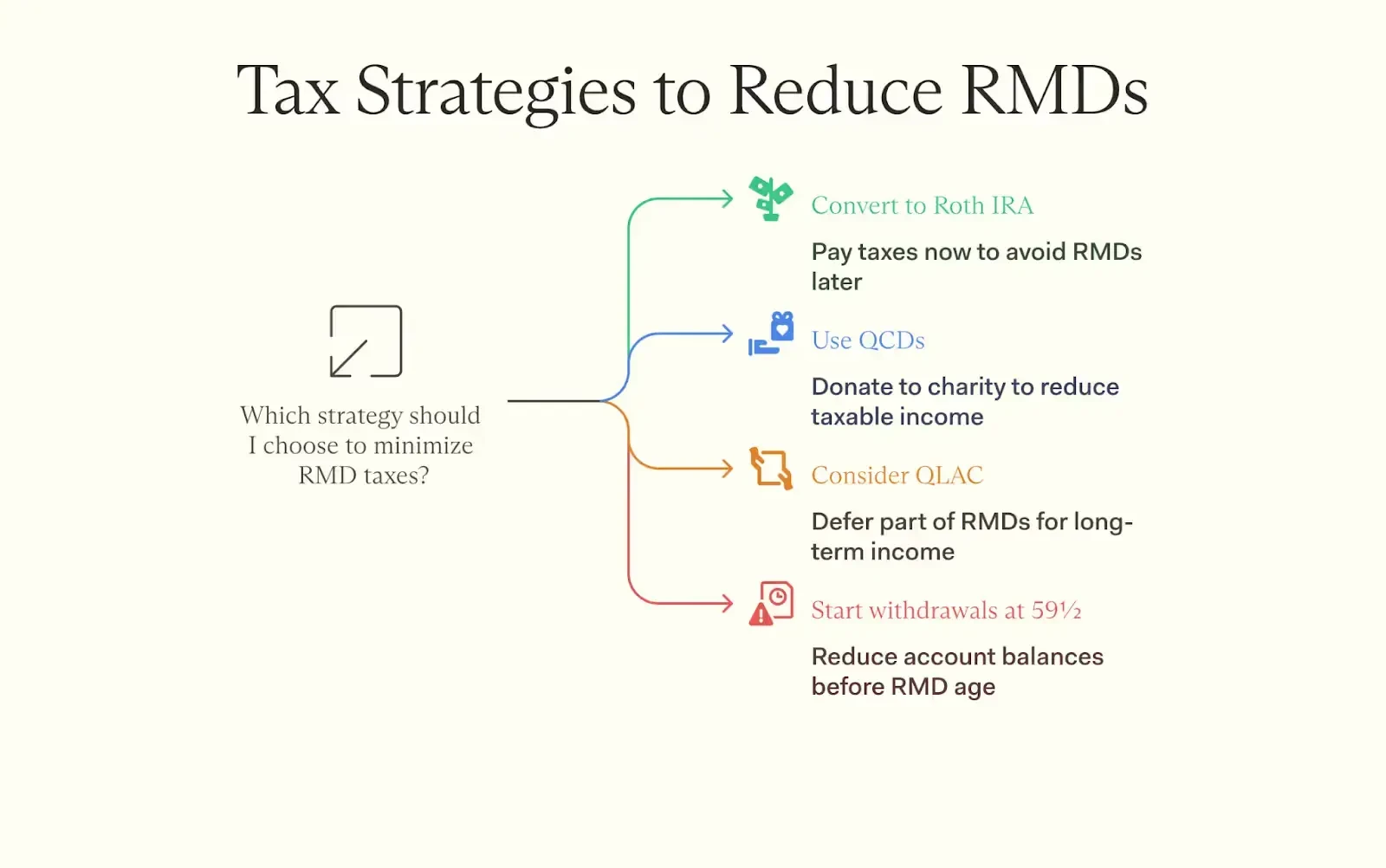
Yes, there are legitimate ways to reduce the tax impact of required minimum distributions. The right approach depends on whether you want to lower taxable income this year or reduce future withdrawal requirements.
Those are different goals.
A qualified charitable distribution may keep an eligible IRA withdrawal out of taxable income today. A carefully planned Roth conversion may reduce future RMDs, but usually creates taxable income when you convert.
Before choosing a strategy, understand what your RMD represents, which rules apply to your accounts, and how the withdrawal fits alongside your other income. You can start from the RMD calculator to see the amount you are planning around.
Understand What Actually Gets Taxed
An RMD is the minimum amount you must withdraw from certain retirement accounts. It is not the amount of tax you owe.
Traditional IRA distributions funded entirely with pretax money are generally taxable as ordinary income. If you have documented after-tax basis, part of a distribution may be nontaxable.
For example, a $12,000 taxable RMD adds $12,000 to income before applicable deductions and other tax calculations. It does not create a $12,000 tax bill.
Your actual tax depends on your filing status, total income, deductions, and other circumstances. Start with that wider picture before trying to reduce the bill.
Use Qualified Charitable Distributions for Planned Giving
If you already give to charity, a qualified charitable distribution, or QCD, deserves consideration.
A qualifying transfer goes directly from an eligible IRA to an eligible charity. It can count toward your IRA RMD while being excluded from taxable income.
You must be at least 70½ when the distribution occurs. For 2026, the annual QCD exclusion limit is $111,000 per eligible individual, subject to the applicable rules and adjustments.
Deductible IRA contributions made after age 70½ can reduce your excludable QCD amount under special rules.
Suppose your RMD is $20,000 and you plan to donate $5,000. A qualifying $5,000 QCD can satisfy that portion of the requirement, leaving $15,000 to withdraw for yourself.
$20,000 RMD − $5,000 QCD = $15,000 taxable · at a 22% rate, excluding $5,000 saves about $1,100 of federal income tax
Assuming the remaining amount is fully taxable, only $15,000 enters income from those distributions. At a constant 22% marginal federal rate, excluding $5,000 would represent $1,100 of federal income tax savings, ignoring other interactions.
You cannot also claim a charitable deduction for the excluded QCD. Taking money personally and donating it afterward does not make that withdrawal a QCD.
Arrange the charitable transfer before taking money intended for the donation, and keep the required acknowledgment. Donating solely to save tax still leaves you with less money; this strategy fits giving you already want to do.
Consider Roth Conversions Before Larger RMDs Arrive
A Roth conversion moves eligible retirement money into a Roth IRA. The untaxed amount converted generally becomes taxable income in the conversion year.
The potential benefit comes later: Roth IRAs have no lifetime RMD requirement for their original owners.
Reducing a traditional IRA balance through conversions may therefore reduce future required withdrawals. However, that does not guarantee lower lifetime taxes.
A conversion during a relatively low-income year may cost less than withdrawing the same money during a future higher-income year. A large conversion can also push more income into higher tax brackets now.
Compare the immediate tax cost with the possible future benefit. Smaller conversions spread across several years may be worth evaluating.
You cannot convert your RMD itself into a Roth IRA. In an RMD year, satisfy the required distribution before converting additional eligible IRA funds. A conversion does not remove that year’s existing withdrawal requirement.
Not sure when your own withdrawals begin? The RMD starting-age calculator works out your first distribution year from your birth date, which is when conversion planning usually starts.
Compare Both Years Before Delaying Your First RMD
If you turn 73 in 2026, you can generally delay your first traditional IRA RMD until April 1, 2027. But your second RMD remains due by December 31, 2027.
Waiting may put two taxable distributions into 2027. Taking the first during 2026 instead spreads them across two tax years.
For someone expecting similar income in both years, concentrating withdrawals might increase the overall tax cost. For someone expecting much lower income next year, waiting could still make sense.
Compare both scenarios using your expected income. The latest permitted withdrawal date is not automatically the most tax-efficient choice. Our guide to the first RMD deadline walks through the April 1 rule and the double-withdrawal year.
Preserve Records of After-Tax IRA Contributions
If you made nondeductible traditional IRA contributions, you may have basis that should not be taxed again when distributed.
Form 8606 generally tracks that basis and calculates the nontaxable portion of relevant distributions.
You cannot usually select only after-tax dollars from one IRA while ignoring pretax amounts elsewhere. The calculation generally considers your traditional, SEP, and SIMPLE IRAs together under the applicable rules.
Find prior Forms 8606 and contribution records before preparing your return. If records are incomplete, resolve the missing information with your tax preparer.
This does not eliminate the RMD. It helps ensure the taxable portion is calculated correctly.
Coordinate Withdrawals Beyond the Minimum
Your RMD is a floor, not a suggested spending target. You may withdraw more, but additional taxable distributions can increase your tax bill.
Suppose you need money for a home repair after satisfying your RMD. Before requesting another IRA withdrawal, compare your available savings and other funding sources.
A qualified Roth withdrawal may provide cash without increasing federal taxable income. Using existing bank savings may also have different tax consequences from taking another traditional IRA distribution.
The right choice depends on your broader plan. Preserve sufficient accessible savings and avoid making decisions based only on this year’s tax return.
Check Whether a Workplace Plan Allows Deferral
If you are still employed, your current employer’s retirement plan may allow you to postpone RMDs until retirement, provided you meet the ownership restrictions. That could defer taxable distributions from that plan.
However, this exception generally does not cover traditional IRAs or plans with former employers. Deferral also postpones taxation rather than guaranteeing that the eventual tax will be lower.
Ask the plan administrator to confirm eligibility before changing any scheduled withdrawals. The 401(k) RMD calculator estimates plan withdrawals separately from your IRAs.
Compare What Each Strategy Can Achieve
| Strategy | Possible benefit | Key limitation |
|---|---|---|
| Qualified charitable distribution | Excludes eligible giving from income | Requires qualifying charitable transfers |
| Roth conversion | May reduce future RMDs | Usually creates taxable income now |
| First RMD timing | Spreads withdrawals between years | Requires comparing both tax years |
| Accurate basis reporting | Prevents taxation of recovered basis | Depends on records and allocation rules |
| Workplace plan deferral | Postpones certain required withdrawals | Limited eligibility and plan permission |
These approaches solve different problems. You may find that one applies, several work together, or none offers enough benefit to justify a change.
Avoid Confusing Withholding With Tax Savings
Reducing withholding increases the cash deposited into your bank account. It does not, by itself, reduce your final tax liability.
Likewise, dividing the same taxable annual withdrawal into monthly payments generally does not lower the income reported for that year.
Keep withholding and estimated payments aligned with your actual obligations. Paying too little during the year can create an underpayment penalty. The RMD tax withholding calculator shows how your selected rates change the net amount you receive.
Review any strategy before the distribution is processed, especially when charitable transfers or conversions are involved.
Conclusion
You may reduce taxes connected to RMDs through qualified charitable distributions, thoughtful timing, accurate basis reporting, and planning for future withdrawals.
Start with your required amount and expected income. Then compare the available choices with a qualified tax professional. The most useful strategy improves your overall retirement plan while meeting every withdrawal deadline.
Source: IRS guidance on required minimum distributions and qualified charitable distributions at irs.gov. Educational estimate only, not tax advice.