
RMD Calculator Results Differ: How to Check the Inputs
By RMDCalculators.com · Published
You enter your retirement balance into two RMD calculators and receive different answers. One says you must withdraw $18,868. Another shows $19,608. Which result should you trust?
Start by comparing the inputs, not the websites' names. Calculators can use different years, account balances, beneficiary assumptions, or definitions of the amount displayed.
For a straightforward account, matching the correct inputs and IRS factor should produce essentially the same required minimum distribution. Small rounding differences are possible. Larger differences deserve an explanation before you schedule a withdrawal.
Start With the Basic RMD Formula
For most owners calculating an annual RMD from a traditional IRA, the formula is:
Previous December 31 account balance ÷ applicable IRS distribution factor = annual RMD
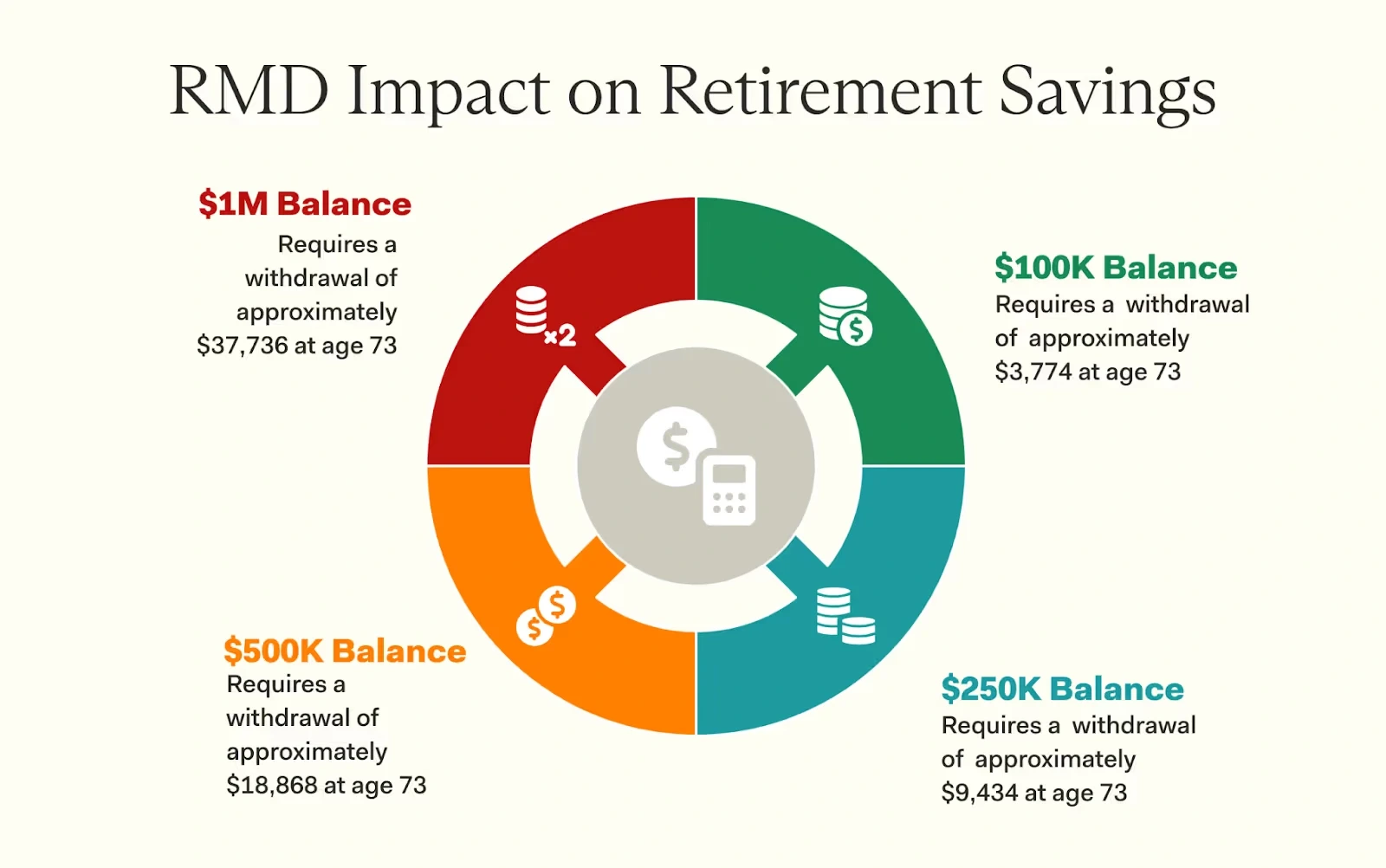
Suppose your December 31, 2025, balance was $500,000 and you turn 73 in 2026. Using the Uniform Lifetime Table factor of 26.5:
$500,000 ÷ 26.5 = $18,867.92
This gives you a reference point. If another calculator produces a different amount, check the balance and factor it used. The discrepancy often becomes clear once those two numbers are visible. Our step-by-step RMD calculation guide walks through the same formula in more detail.
Check the Distribution Year First
Make sure both tools are calculating the same year's RMD. A calculator may default to the current year, while another retains a year from an earlier visit.
For a 2026 RMD, you generally use the December 31, 2025, account balance and your age reached during 2026.
The payment year can also cause confusion. If you delayed your first 2025 RMD until April 1, 2026, it remains your 2025 RMD. Paying it in 2026 does not change its balance date or age factor, and it does not replace your separate 2026 obligation. Our first RMD deadline guide explains that timing rule.
Use the Correct Account Balance
Enter the prior December 31 value, not today's balance, your original contributions, or only the account's cash holdings.
An IRA containing stocks, bonds, and cash generally uses the total account value. A market decline after December 31 normally does not reduce that year's calculated RMD.
For example, entering $550,000 instead of $500,000 at a 26.5 factor raises the result from $18,867.92 to $20,754.72.
Transfers can complicate the records. A new provider may need the account's previous year-end value from the former custodian. Outstanding rollovers or corrected valuations may also require adjustments. Ask the provider to reconcile those details rather than estimating them.
Confirm the Age the Calculator Uses
RMD calculations generally use the age you reach on your birthday during the distribution year. Your age today may be different if your birthday has not happened yet.
If you turn 73 in December 2026, use age 73 for your 2026 calculation, even when checking it in March.
Using age 74 instead changes the Uniform Lifetime Table factor to 25.5. On a $500,000 balance, that produces $19,607.84 instead of $18,867.92.
Entering your full birth date can reduce this mistake, but still check the year and age shown in the result. Our RMD starting age calculator confirms which year your first withdrawal falls in.
Compare the IRS Table and Spouse Settings
Most owners use the Uniform Lifetime Table, also called Table III. However, Table II applies when your spouse is more than 10 years younger and qualifies as your sole beneficiary.
Both conditions matter. A younger spouse who shares primary beneficiary status with your children generally does not qualify you for that exception. Our guide explains which RMD table applies when your spouse is younger.
A calculator that never asks about your spouse might assume the standard table. Another may use your spouse's information and produce a smaller withdrawal.
Also confirm that the tool uses current IRS tables. Revised life expectancy tables became effective in 2022, so an outdated spreadsheet can produce different results even when the balance and age match. You can look up the current factors in our RMD tables reference.
Make Sure You Selected the Right Account Type
An owner calculator and an inherited IRA calculator answer different questions. Do not enter an inherited account into an ordinary age-based calculator and assume the result applies.
Inherited calculations can depend on the owner's year of death, whether death occurred before the required beginning date, your beneficiary category, and the account's distribution history. A 10-year payout deadline does not automatically mean dividing the balance by 10. Our inherited IRA RMD calculator handles beneficiary cases.
Roth IRAs have no lifetime RMDs for their original owners, but beneficiaries face distribution rules. Certain employees may also qualify to delay RMDs from a current employer's plan. That exception generally does not apply to traditional IRAs.
Separate Annual RMD From Remaining RMD
One screen might show your full annual requirement. Another might subtract withdrawals already recorded and show only what remains.
Suppose your annual RMD is $18,867.92 and you have already taken $8,000 that counts toward it. Your remaining amount is $10,867.92. Both figures can be correct.
Check whether the calculator asks about previous distributions and whether those withdrawals belong to the same RMD year. A provider's dashboard may not reflect eligible withdrawals taken from accounts held elsewhere.
Keep distribution confirmations so you can reconcile the amount already satisfied without counting the same payment twice.
Compare Gross Withdrawals With Net Deposits
Tax withholding creates another apparent mismatch. The gross distribution includes money sent to tax authorities; the net deposit is what reaches your bank.
If you withdraw $10,000 and have $2,000 withheld, your bank receives $8,000. The gross $10,000 generally counts toward the RMD. Our RMD tax withholding calculator estimates that net payment.
Do not compare an after-tax cash estimate with a gross annual withdrawal requirement. Likewise, a monthly equivalent is simply a budgeting figure. Dividing the annual RMD by 12 does not create a separate IRS monthly requirement.
Check Whether You Are Comparing Projections
A current-year RMD uses an established prior year-end balance. A future projection must make assumptions about investment returns, withdrawals, and account growth.
Two tools can agree on today's requirement and disagree about withdrawals five years from now because their assumptions differ.
Match the assumed return, projection period, and withdrawal timing before comparing those forecasts. Treat projected amounts as planning estimates that will need updating as actual balances become available. Our RMD projection calculator lets you set those assumptions yourself.
Use This Comparison Checklist
| Input or output | What should match |
|---|---|
| Distribution year | The year the RMD satisfies |
| Account value | Correct prior December 31 balance |
| Age | Age reached during that year |
| Beneficiary details | Spouse's age and sole beneficiary status |
| IRS table | Applicable table and factor |
| Account coverage | Same accounts and balances |
| Displayed amount | Annual, remaining, gross, net, or projected |
Compare individual accounts first. Do not assume an IRA withdrawal can satisfy a separate 401(k) requirement. Our 401(k) RMD calculator covers workplace plans separately.
Allow for Rounding, Then Investigate Larger Gaps
A result of $18,868 and another of $18,867.92 reflect ordinary display rounding. By contrast, a difference of several hundred dollars is unlikely to come from rounding alone.
Use the published IRS factor rather than a rounded withdrawal percentage when checking the arithmetic. Multiplying a balance by 3.8% will not exactly reproduce division by 26.5.
If the discrepancy remains, save both results and their inputs. Ask the custodian which balance, table, factor, and prior withdrawals support its figure. Do not average the answers or automatically choose the lower one. Confirm the amount before the deadline, and seek a tax professional's help if an incorrect withdrawal has already created a shortfall.
Conclusion
Different RMD calculator results usually call for a careful comparison of inputs and assumptions. Match the year, balance, age, table, account type, and withdrawal history. If the numbers still disagree, ask your custodian to explain the calculation in writing before relying on either result. You can run your own numbers with our main RMD calculator.
Sources: IRS Publication 590-B. Educational information only, not tax advice.